

For most of the journey from Salem, Illinois, to St. Louis, this was the view out the window:

Literally, endless, endless fields. Most of the towns we passed through were little more than a collection of houses, a commercial business or two, and then more fields.

As we came to Carlyle, Illinois (known for its man-made lake, the largest in Illinois), I noticed this odd suspension bridge about 100 feet from the highway, spanning the Kaskaskia River. Despite its immense design, it was strangely only about four feet wide, and didn’t seem to lead anywhere in particular.

As it turns out, it is known as the General Dean Suspension Bridge, and from 1861 to 1920, was the primary means of crossing the river. Countless travelers crossed it by foot, horseback, covered wagon, and finally, by car over six decades. Finally, it was replaced by a more modern bridge along the US-50 path, and was abandoned. Having fallen into disrepair, it was saved in 1951 when it was converted to a pedestrian bridge.

Downstream, a group of teenagers were shooting at fish with some serious-looking crossbows (not something I regularly encounter on the East River).

Though most of the towns we passed through in Illinois were very small and nearly deserted, there were still a lot of interesting details to find.

A beautiful bank in downtown Carlyle:

I especially like the neon sign – with clock!

Another great neon sign – this one in Breese, Illinois (one town west of Carlyle):

One thing I love about older signs is how humble they often are. For example, the Trenton House Restaurant: Good Food. Great? Excellent? No, but it is good.

Another great sign for a place that appears to be out of business in Trenton:

A very patriotic building:

At one of US-50’s 90-degree turns, we came across what has to be the prettiest small town along the route through Illinois: a little town called Lebanon (apparently pronounced by residents as Leba-nun).

Madison Street, the main drag just a block from US-50, is bricked (note the marks from a rail line which used to pass through town) and lined with beautiful historic buildings and globed streetlights.

Lebanon might not be the number one small-town tourist destination in the state (it was basically deserted as we walked through, with every store closed), but you’d never know it from the condition of the buildings.

A corner restaurant:

My favorite shop in Lebanon was this magic parlor…

Looking through the window, it’s exactly the sort of intimate magic shop directors often ask us to scout for (and NYC has none of, sadly). I mean, they’ve got a coffee can full of magic wands!

Great window display:

Worn hard-wood floors are a requirement for any good magic shop:

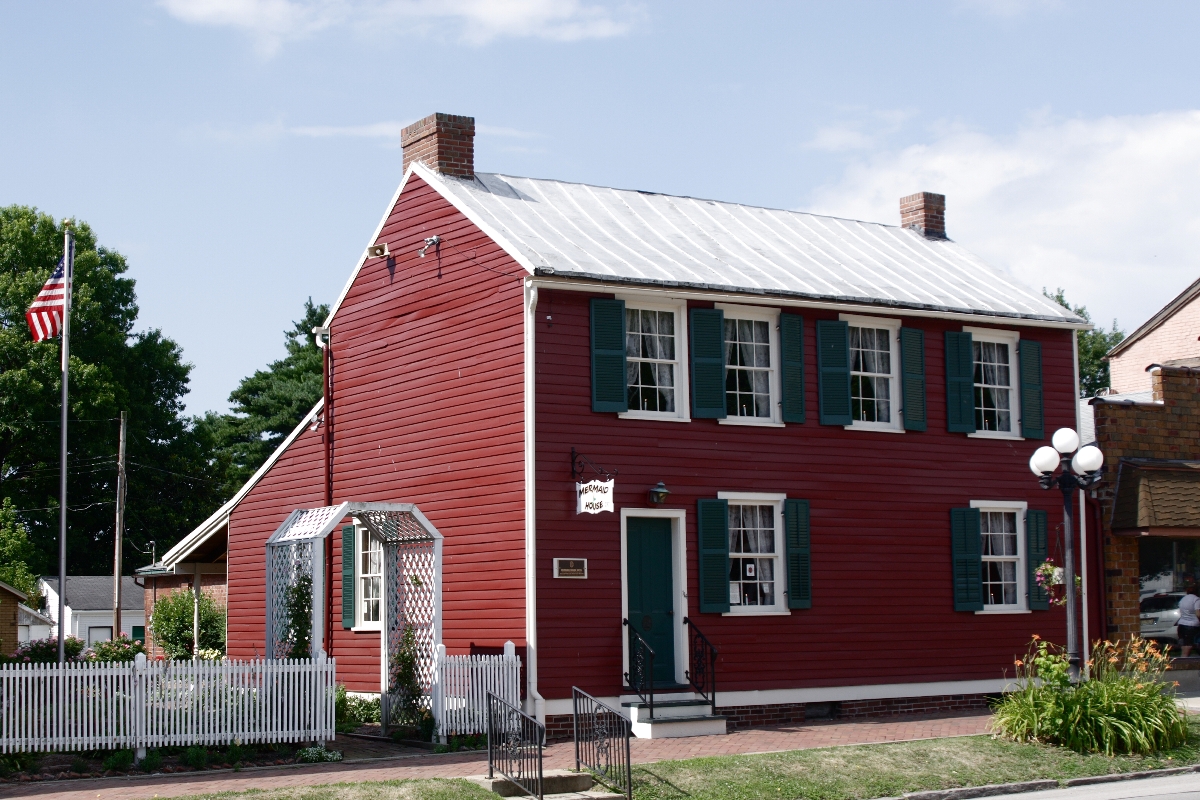
We didn’t see it, but Lebanon is also home to the historic Mermaid House Hotel, built in 1830 by Captain Lyman Adams and named for the mythical creatures he claimed to have seen at sea. Charles Dickens stayed at the Mermaid House Hotel in 1842, and later wrote in his book American Notes: “We lay at the little inn at which we had halted in the afternoon. In point of cleanliness and comfort it would have suffered by no comparison with any English alehouse, of a homely kind, in England.”
Shortly after Lebanon, US-50 merges with Interstate-64 for the rest of the trip into St. Louis…but not before we saw this beautiful pond covered in yellow flowers and lily pads:

And then we saw it in the distance: the arch!

St. Louis next!
-SCOUT


Leave a Reply