

Some time ago, I was scouting Upper West Side lobbies when I came to the apartment building at 253 W 73rd Street.

Tucked away behind the palatial Ansonia, I’d honestly never noticed it before, and decided to take a peek inside.

At first, the entrance seemed like your typical building lobby – a desk to one side, an alcove with mailboxes beyond. Then I went a little further in…

…and wow:

Seriously – how beautiful is this?

But what exactly had I stumbled on? Had the property always been an apartment building, or was there more to the story?

As it turns out, the property was originally built by a group of Freemasons in 1927 known as the Levelers. The first Masonic clubhouse/hotel of its kind in the United States, the Level Club offered its members 225 bedrooms and such state-of-the-art amenities as a fully equipped gym, handball courts, “azure” swimming pool, Turkish baths, a solarium, bowling alleys, a grill, a barber shop, a manicurist, a lounge, dining rooms, a ballroom, an auditorium, a banquet hall, and a roof garden.

Its origins with the Freemasons explain the building’s facade, which, on closer inspection, is absolutely dripping in Masonic symbols and imagery. Look just above the door…

…and you’ll find the all-seeing eye…

The square and compasses…

…an hourglass…

…and an emblem with LC for the Levelers Club:

Further up, numerous hexagrams dot the facade:

It gets even crazier. According to author Bruno Bertuccioli, who spent years writing a comprehensive history of the building (which you can purchase here), the Level Club was designed as a “true-to-size rendering of King Solomon’s Temple,” the only one of its kind in the entire world (in case you’re wondering, Ivo Shandor was not the architect).

In the center, you’ll find a pair of pillars representing the entrance to King Solomon’s Temple…

…held up by sculptures of Hiram Abiff and Solomon himself:

The ornate lobby has been beautifully preserved and is much the same as it was originally built, although now with a lighter paint job. Originally, there would have also been a cigar department, theater tickets booth, barber shop, check room, shoe polishing service, and phone booths.

The lobby is centered on an imperial staircase, which leads down from a wrap-around mezzanine balcony level:

These mirrored doors once led into the Palm Room, a meeting room decorated with live plants, and the dining rooms.

On the far wall, a set of elevators. Note the whimsical designs along the top, and the interesting array of geometric patterns:

A chandelier hangs from the inlaid ceiling:

Among the many additional public spaces were the auditorium, seen below in 1927…

…and billiard room:

Sadly, the Level Club closed a mere two years after it opened due to the Great Depression. It later re-opened in the mid-1930s as the Riverside Plaza Hotel, a weekly hotel for men. The below postcard advertises most of the same amenities originally available to Level Club members: “400 Rooms, modernly equipped, all with Bath, Radio; Gymnasium, Swimming Pool, Handball Courts, Bowling. New York’s Finest Banquet Facilities.”

The hotel’s bowling alleys, pictured below in 1927, had one particularly famous patron…

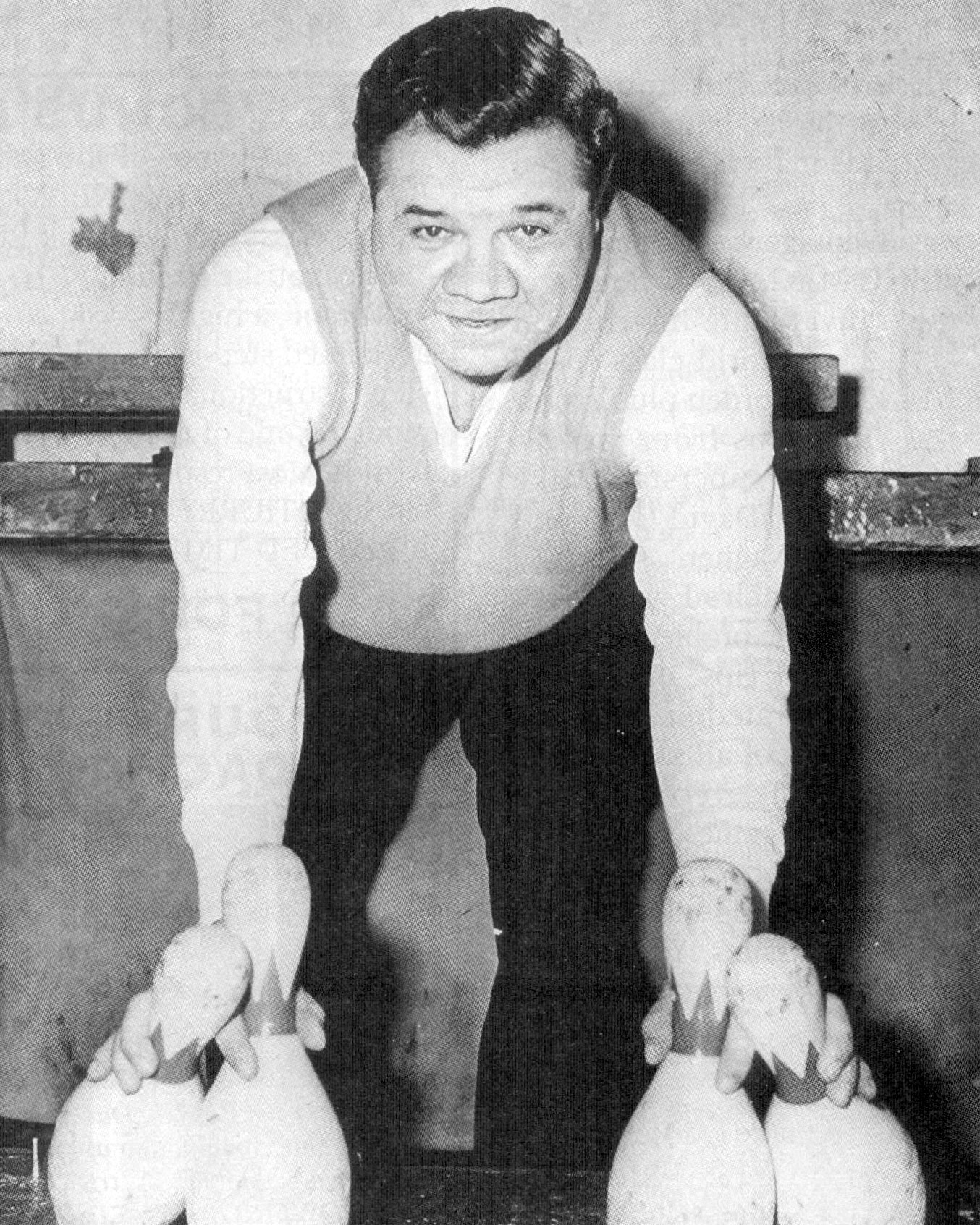
…Babe Ruth, who lived nearby and frequented the lanes as often as five days a week (his average was 177). Below, Ruth personally sets up pins in 1942, as the War had caused a pinboy shortage:
A Riverside Plaza hotel card signed by Ruth was recently sold at auction:

A matchbook from the Riverside Plaza:

Finally, one of those strange 1950s postcards that lops out all the surrounding buildings:

The hotel struggled through the 1960s (it was then a kosher hotel), and by the 1970s, had become a drug and alcohol rehabilitation center operated by Phoenix House. Phoenix House sold it in the mid-80s, and it was turned into an upscale condominium. The lobby was fully restored, and the Level Club name returned to the property.
Tragically, none of the club’s original function/recreation rooms survive. The auditorium in particular was in a state of total disrepair, with much of its ornamentation destroyed or stolen. These spaces were converted into additional apartments, resulting in a building filled with quirkily-shaped living spaces – varying ceiling heights, different style hallways, and the occasional detailing left over from a past iteration of a room. Below, the (oddly-painted) penthouse apartment as pictured in the NY Times shows the mishmash of spaces:

From Masonic private club to men’s hotel to drug rehab center to upscale condo, it’s incredible that the building has survived to this day in such great shape. Let’s hope it stays that way as the cycle inevitably turns in a new direction.

For a comprehensive look at the building’s history, be sure to check out The Level Club by Bruno Bertuccioli (unfortunately, out of print).
-SCOUT
PS – Unfortunately, the lobby is for residents only, and not open to the public.


Leave a Reply